

37 deployed agents per enterprise, growing quarterly.
AGAT 2026
Agentic AI Interoperability is how GlobalizeWe connects agents, models, tools and data across the systems you already run — sovereign, hybrid, cloud or air-gapped — with policy gates, receipts and human authority built into every execution. No rip-and-replace of the people or the technology. From scratch, or rescue.
37 deployed agents per enterprise, growing quarterly.
AGAT 2026
14.4% of agents reach production with full security and IT approval, while 82% of executives believe their policies cover them.
AGAT 2026
67% of executives believe their company already had a leak or breach through unapproved AI tools.
WRITER 2026
A shadow-AI incident costs about $670,000 more than a standard one.
AGAT 2026
4.3 hours a week verifying AI output, about $14,200 per employee per year in remediation.
Forrester
47% of enterprise users made at least one major decision on hallucinated content.
Deloitte
Fewer than half expect to pass a compliance review of agent behavior.
CSA / Strata 2026
Sources: AGAT 2026 · WRITER 2026 · Forrester · Deloitte · CSA / Strata 2026.
Map · Govern · Operate · Prove. Each plane is one mechanism and one thing the buyer can see change.
Manta Graph™ names the agents, systems, and authorities already in the estate.
The map is in hand before another agent is added.
GW Slate™ holds a policy gate before an agent acts.
The gate records the authority for the action.
Iris Meridian™ routes the task to the model and the data that fit the situation.
The work uses the context the policy allows.
Receipt Rail™ writes the receipt after the action.
The enterprise can show who acted, under which policy, and what came back.
The same controller. The same receipts. Data stays where the law and the CISO put it.

Human authority sits at the control points. Agent accountability sits in the receipt. Responsibility is fundamental to the execution path, so a pilot has a way to become an operation.
Analog-to-Digital Sprint for legacy estates. Frontier Diagnostic Sprint for stalled pilots. Each is $7,500 standard · $10,000 regulated, and 100% of the Sprint fee credits toward GW Slate™.
A wrapper passes a request to a model and returns whatever comes back.
A rail decides what may happen, routes the work to the model and the data that fit the situation, holds the outcome against a standard, and produces a receipt. Iris Meridian™ operates the rail. GW Slate™ is the controller.
Llama, Grok, Perplexity, Hugging Face, the frontier APIs, and sovereign local models are destinations the rail routes to under policy. Custom MCP servers, A2A, REST, and GraphQL are how it connects.
Tool and context exchange into the systems you already run.
Task exchange between agents, under the same policy gate.
Content credentials on output that leaves the rail.
Runtime traces the operator can read beside the receipt.
Supply-chain integrity and attestation for the execution path.
Identity for the agent and the workload it calls.
It covers the governed exchange of context, tasks, and results across the agents, models, tools, and data an enterprise already runs. GW Slate™ holds identity and the policy gate. Iris Meridian™ operates the rail. Receipt Rail™ keeps the proof.
Sovereign, hybrid, cloud, and air-gapped. The same controller and the same receipts apply in each posture. Data stays where the law and the CISO put it.
Responsibility sits on the execution path. A person holds authority at the control points. The agent accounts for its action in the receipt. That is how a pilot becomes an operation.
Legacy estates start with the Analog-to-Digital Sprint. Estates with a stalled pilot start with the Frontier Diagnostic Sprint. Each fee is $7,500 standard · $10,000 regulated, and 100% of the Sprint fee credits toward GW Slate™.
MCP, A2A, C2PA, OpenTelemetry, SCITT / RATS, and OAuth / SPIFFE. Custom MCP servers, REST, and GraphQL connect the rail to the systems you already run.
Canonical pieces on this rail. Each magazine URL is the home; Substack is distribution.
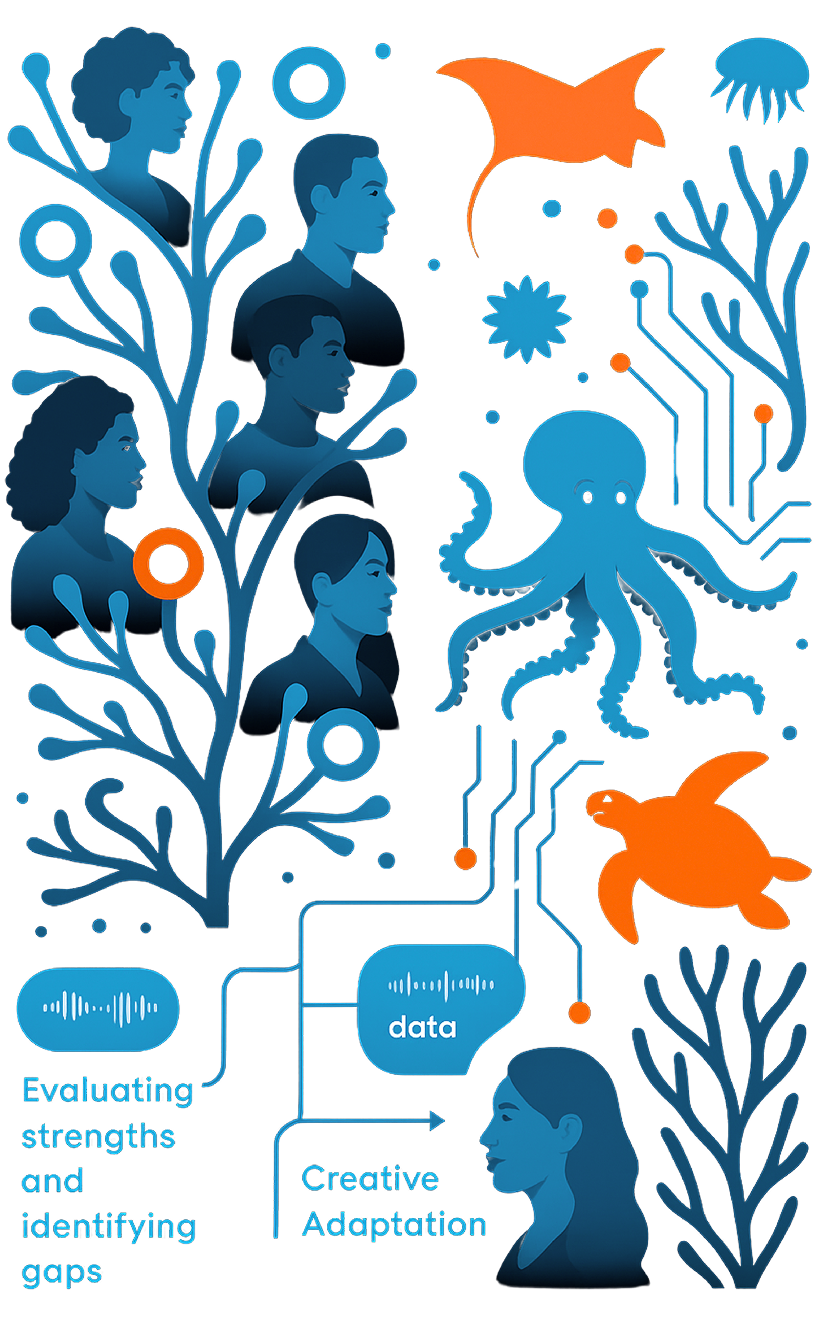
GlobalizeWe's design analogy for distributing agentic work across specialized, policy-aware Coral Reef Nodes™, each carrying a bounded role inside a governed mesh.
Agentic AI interoperability means agents exchange typed task state and coordinate action without losing identity, policy, provenance, or outcome accountability.
The modular mesh the runtime runs on.
Custom MCP servers, adapters, and model routes, tested before they reach the controller.
Creative rails bound to organizational policy.
The controller: identity, policy, context, and proof.
Agentic Enrichment Architecture™ sets the conditions before inference.
Uplift the estate you already pay for.