
PATH 01
Direct model sequence
One prepared prompt, one model route, one final manual review.
- Workflow steps
- 4
- Evidence-bound
- 2 / 4
- Human gates
- 1
- Open conflicts
- 2
Disposition: comparison path
Direct answer
A Manta Graph™ diagnostic returns three artifacts you keep: a visual topology of how people, systems, policy, and evidence actually connect; an executable schema engineers can run; and a compute-and-token economics view finance can size. It never grants authority and never mints proof — those belong to GW Slate™ and Receipt Rail™ after the map is legible.
The relational knowledge-graph journey
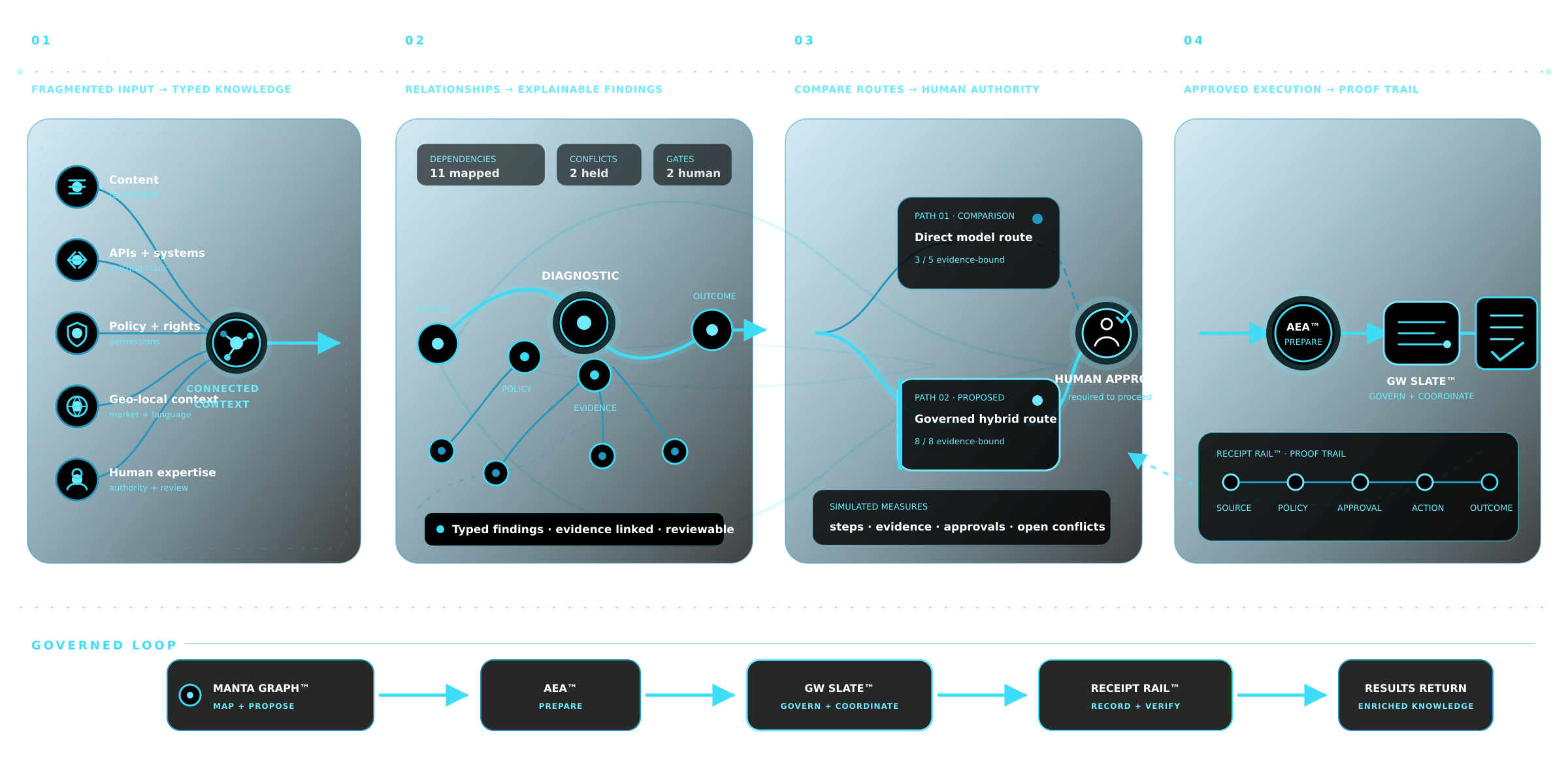
Every stage produces something you can inspect — not a black box.
Connect your systems, content, policy, and people into one map instead of scattered point solutions.
See what's duplicated, missing, or stuck — and where the real opportunities sit.
Compare the simplest reliable paths, explain the tradeoffs, and keep named human-at-the-control at the boundary where consequence matters.
Run the approved path through AEA, GW Slate, and Receipt Rail — then feed what you learned back into the graph.
Interactive explainer · sample data
Pick a sample, inspect the relationships, compare two routes, and see what happens after approval.
One graph, many estates. The intake changes with the objective — market programs, document sets, product knowledge, a digital property under active build. The sequence holds: map what is truly in play, prepare the context, propose routes, bind authority, execute under control, return proof. It runs on the systems already in place — no retraining, no replacement, no new stack to buy.
A mid-market enterprise ships a production web property with AI build agents. Six days of work produce two governance failures. Every piece of evidence needed to catch both sits in the estate the entire time.
Illustrative scoring for the selected deterministic sample.
Swipe
Sample measures reflect this deterministic demonstration only.
One prepared prompt, one model route, one final manual review.
Structured context, hybrid retrieval, specialist routing, and named approvals.
Interconnected responsibilities
Manta Graph proposes. AEA prepares. GW Slate governs. Receipt Rail records.
Finds the relationships, dependencies, and fit that actually matter.
Identity, policy, and context — ready before a model ever runs.
Coordinates approved models and tools across the stack you already run.
A clear record of what happened and why.
Product applications
Keep every localized version tied to the approved claim, terms, and market context.
Connect source documents, content, and policy into one searchable, trustworthy asset.
Map what each system can do, who owns it, and what approval it needs.
Spot where language, culture, or local rules change what's allowed to ship.
Find affected assets, gaps, and the fastest sequence to fix them.
Weigh delay, rework, cost, and risk before picking how work gets done.
The Manta Graph diagnostic
Control matched to consequence
Human-led, logged inputs and outputs, named owner, manual approval.
Identity, eligible sources, policy checks, scoped tools, decision trace, receipt.
Jurisdiction rules, resident data handling, mandatory approval, retention controls.
Isolated runtime, fail-closed controls, signed policy, cryptographic provenance, evidence any holder can verify.
Glossary
The graph, the topology, and Manta Graph™ itself, in the sentences this page publishes.
Answer engine reference
Manta Graph™ is GlobalizeWe's relational knowledge graph. It maps the dimensionality of siloed enterprise data — people, systems, policies, evidence, decisions, and outcomes — then proposes typed routes a small local model can run against.
Manta Graph maps the work and proposes a route. GW Slate™ decides whether that route can run.
AEA™ — Agentic Enrichment Architecture — prepares identity, policy, and context before a model ever runs.
A record of what sources were used, what was decided, and what happened — tamper-evident by default.
No. This experience uses sample data to explain the method. Live work happens on authenticated GlobalizeWe.io deployments.
It maps relationships across the systems you already use — CMS, DAM, CRM, ERP, identity, models, APIs. Nothing gets replaced.
Vector search finds what's similar. Manta Graph resolves how things connect. A hybrid route uses both when a workflow needs each.
Tier 1 is a Visual Topology — the workflow map at exec and board depth. Tier 2 is an Executable Schema in JSON, GraphQL, Terraform, and LangGraph-ready form with air-gapped boundaries and API hooks. Tier 3 is the Token Economy Audit — the compute cost of the workflow at scale, broken down by node and model, so finance can size the program.
The topology-mapping fee credits in full toward GW Slate™ implementation if you proceed within 90 days. The Manta Graph™ topology mapping is the evidence; the GW Slate™ value calculator shows what that evidence is worth across the full program.
A relational knowledge graph maps how entities actually connect — people, systems, data, policies, evidence, decisions, and outcomes as one connected map. Manta Graph™ is GlobalizeWe's relational knowledge graph: it makes the dimensionality of siloed enterprise data legible, then proposes typed routes a small local model can run against.
Small local models perform when the context is already shaped. Manta Graph™ maps the data topology first, then proposes typed, evidence-linked routes so a small local model runs against the right subgraph — before a frontier model is ever chosen.
Canonical pieces on this rail. Each magazine URL is the home; Substack is distribution.
A field guide to the eight tests a global asset passes when people and AI both read it, and how GeoLineage™ traces each one from legacy systems to every market.
Part 1 of Agent Topology. Fan-out and tiering replace a linear agent chain with a graph that sets what enterprise agents can execute.
Material developments in off-grid, sovereign, ruggedized, and intermittently connected AI—interpreted for enterprise operating decisions.
GlobalizeWe's design analogy for distributing agentic work across specialized, policy-aware Coral Reef Nodes™, each carrying a bounded role inside a governed mesh.
Agentic AI interoperability means agents exchange typed task state and coordinate action without losing identity, policy, provenance, or outcome accountability.
GW Slate™ is GlobalizeWe's modular controller for agentic AI — binding identity and policy, enforcing approval boundaries, and producing attributable receipts.
Map one consequential workflow, govern it, and scale what works — with proof at every stage.